
Try this chapter on paper
Use the original practice PDF after studying. Answers and marking guidance are included. No sign-in needed.
Class 8 Maths sample paper: Fractions in DisguisePick one topic. Use the video where shown, read the short explanation, then try the question before checking your answer.
1. Fractions, decimals and percentages
Watch: Fraction, decimal, and percent from visual model
Khan Academy
Video not loading? Watch on YouTube (opens in a new tab)
Understand it
A fraction, decimal and percentage can name the same share of a whole. For 7/20, divide 7 by 20 to get 0.35, or make an equivalent fraction 35/100. Both give 35%. Multiplying the decimal by 100 changes the notation to percent; it does not change the represented share.
Use a benchmark to catch place-value errors: 7/20 is more than 1/4 but less than 1/2, so its percentage should lie between 25% and 50%. The denominator tells you how the whole is divided. Seven shaded parts out of twenty equal parts is not 7% and not 35 whole objects.
Try it yourself
Write 11/40 as a decimal and percentage. Give the unshaded share in all three forms if 11 of 40 equal parts are shaded. Use one-quarter as a check on the shaded answer.
Check: 11/40 = 0.275 = 27.5%, just above 1/4 = 25%. The unshaded share is 29/40 = 0.725 = 72.5%. The shares add to 1, the decimals to 1.000 and the percentages to 100%; 27.5% is not 0.275%.
2. Finding a percentage of a quantity
Watch: Percentages without a calculator - Corbettmaths
corbettmaths
Video not loading? Watch on YouTube (opens in a new tab)
Understand it
A percentage is a fraction of a named whole. Seventeen and a half percent of 240 can be built from 10%, 5% and 2.5%: 24 + 12 + 6 = 42. Equivalently, 17.5/100 × 240 = 42. Write the whole and its unit before calculating. If the whole is a mass, the answer is a mass, not another percentage.
A larger percentage does not always give a larger amount when the wholes differ. You must calculate each share using its own whole. As a reverse check, dividing the amount by the decimal percentage should recover that whole.
Try it yourself
Bag A has mass 360 g, of which 12.5% is red counters. Bag B has mass 200 g, of which 20% is red counters. Which bag has the greater mass of red counters, and by how much? Explain why comparing only 12.5 and 20 would fail.
Check: Bag A has 1/8 × 360 = 45 g of red counters; bag B has 1/5 × 200 = 40 g. A has 5 g more despite its lower percentage, because its whole is larger. The reverse check 45 ÷ 0.125 = 360 recovers A's whole mass.
3. Percentage increase and decrease
Watch: Percentage Change - Corbettmaths
corbettmaths
Video not loading? Watch on YouTube (opens in a new tab)
Understand it
Percentage change compares the change with the original amount: change/original × 100%. A rise from ₹160 to ₹200 adds ₹40, which is 25% of ₹160. Returning from ₹200 to ₹160 removes the same ₹40, but the downward change starts from the original ₹200, so the decrease is 20%. Equal rupee changes need not be equal percentage changes.
For repeated changes, apply each percentage to the amount at that step. A 20% rise multiplies by 1.20; a 20% fall multiplies by 0.80. Their product is 0.96, not 1.00. Writing each new base prevents the tempting but incorrect cancellation of equal-looking percentages.
Try it yourself
A hypothetical price of ₹500 rises by 20%, then the new price falls by 20%. Find both new prices and the net percentage change from ₹500. What percentage reduction from the intermediate price would return exactly to ₹500?
Check: The rise gives ₹600; 20% of ₹600 is ₹120, so the fall gives ₹480. The net change is a ₹20 decrease, or 4% of the original ₹500. To return from ₹600 to ₹500, reduce by ₹100/₹600 × 100% = 16⅔%, not 20%. The two changes use different bases.
4. Applying percentages in context
Watch: Cost price, selling price, profit and loss
Khan Academy India - English
Video not loading? Watch on YouTube (opens in a new tab)
Compare selling price with cost price in the video. It is a basic profit, loss and break-even primer, not a lesson on discount percentages or profit margins. For the original question below, use marked price as the base for a discount and cost price as the base for profit on cost. Name the whole before calculating, and account for other costs and taxes only when the question includes them.
Understand it
A shop buys a bag for ₹720, marks it ₹1,000 and gives a 10% discount on the marked price. The discount is ₹100, so the selling price is ₹900. The profit is ₹900 - ₹720 = ₹180. For profit as a percentage of cost, use ₹720 as the whole: 180/720 × 100% = 25%. A discount can therefore coexist with a profit: the two percentages use different bases.
Write the base beside each calculation. Discount uses marked price; profit on cost uses cost price. Profit margin on sales is a different measure, so do not silently swap the denominator. These examples ignore other costs and taxes. If extra charges are stated, include them as directed rather than assuming this is a final checkout total.
Try it yourself
A shop buys a lamp for ₹640 and marks it ₹1,000. It offers a 20% discount. Find the selling price, profit and profit percentage on cost. Explain why a 20% discount is not a 20% loss.
Check: Selling price ₹800; profit ₹160; profit on cost 160/640 × 100% = 25%. The discount is measured from ₹1,000, while profit or loss on cost is measured from ₹640.
Your five-minute revision
Choose one idea you can now explain and one you still find tricky. Draw a diagram or work an example from memory. Compare with the lesson and fix the step you missed, then retry it tomorrow.
Try an Evater sample paper and choose questions that match what you have practised.
Explore equal parts
One share, three ways to write it
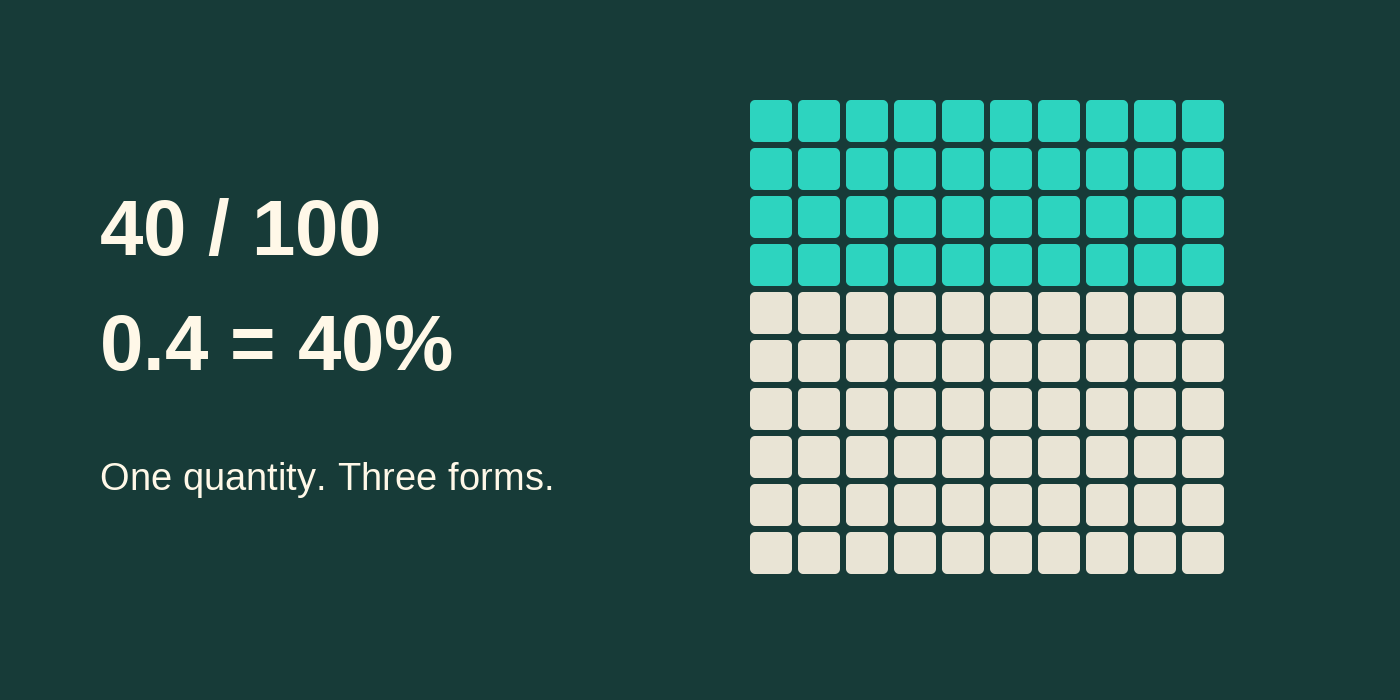
The entire grid is one whole. Every cell has equal area. Predict the percentage, then change the shaded parts. This model shows shares from 0% to 100%; percentages can be greater than 100% in other contexts.
Filled teal: shaded. White: unshaded.
Changing the partition keeps the nearest possible share. Use the shaded-parts slider to choose an exact count.
Shaded: 7/20 = 0.35 = 35%
Unshaded: 13/20 = 0.65 = 65%
The shares add to one whole, or 100%.
Explore changing bases
Does a rise cancel an equal fall?
Use a hypothetical quantity measured in units. The second percentage acts on the result of the first step, not on the original. Negative rates mean decreases. These are 2D mathematical models, not prices, forecasts or financial advice.
Original: 500 units
After first change: 600 units
After second change: 480 units
First: 500 × (1 + 20/100) = 600 units. Change: 100 units.
Second: 600 × (1 − 20/100) = 480 units. Change: -120 units.
Net: -20 units, or -4% of the original 500.
Before checking: start with 400 units, increase by 25%, then decrease by 20%. Do you return to 400? Explain why these unequal rates can undo one another.
Written by
Evater Team