

A number is not the same thing as its written form
Put 17 counters on a table. You can record the collection with seventeen tally marks, the Roman numeral XVII, or the decimal numeral 17. The amount has not changed. What changes is the system used to record it. A useful number system should let someone else recover the amount without guessing, and should make calculation manageable.
This original guide follows Ganita Prakash Part I, Chapter 3: A Story of Numbers. The chapter connects counting, landmark numbers, bases, place value and zero. It compares systems from different cultures. Treat these as different solutions to problems of recording and computing, not a simple story in which one culture copies the previous item on a timeline. The worked examples and questions below are original Evater material, not reproduced textbook exercises.
Counting needs a reliable match
A tally system records one mark for each object. To check two collections without number names, pair one object from the first collection with one from the second. If every object has a partner, the collections have equal size. If one collection has objects left over, it is larger.
The practical weakness is length. Recording 200 objects with 200 separate marks is possible, but inconvenient. Grouping helps a reader see and check the total. For example, 18 counters can be arranged as three groups of five and three loose counters. That describes the quantity without requiring a new special symbol for eighteen.
A group is not automatically a place-value system. You must still specify what each symbol means and whether its position matters. Ask those questions before trying to decode any unfamiliar notation.
Landmark numbers organise the groups
Roman numerals use familiar landmarks such as I for 1, V for 5, X for 10, L for 50 and C for 100. Using the usual modern school convention, XLVII represents 40 + 7 = 47, while LXII represents 50 + 10 + 2 = 62. Order matters in a subtractive pair such as XL. It is therefore too loose to say that order never matters in Roman numerals.
The more precise distinction is that Roman notation is not the decimal positional system. Moving an X does not give it a tens, hundreds or thousands place in the way moving a decimal digit does. Historical writing also contains variations, so first state the convention used in a decoding exercise.
The chapter's Egyptian-style grouping gives a different organising rule: the landmarks are 1, 10, 100, 1,000 and so on. Every landmark is ten times the previous one. Separate symbols for these powers can record how many groups of each size are present. That is a base-ten grouping idea, even before positions replace the landmark symbols.
A base tells you when to regroup
For the whole-number positional systems in this guide, choose an integer base b of at least 2. The place values are 1, b, b², b³ and so on. Each place holds a digit from 0 to b - 1. If a place collects b units, exchange them for one unit in the next place to the left.
In base five the place values are 1, 5, 25, 125 and so on. To write the decimal amount 42, take one group of 25. Seventeen remain. Take three groups of 5, leaving two ones. Thus 42 = 1 × 25 + 3 × 5 + 2, written 132 in base five. It does not mean the decimal amount one hundred and thirty-two.
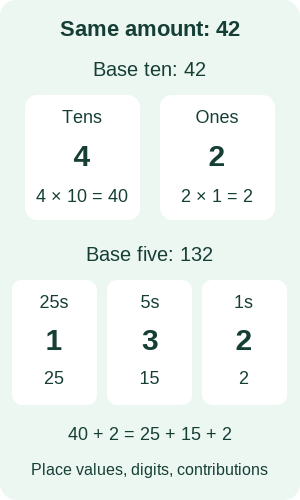
The interactive model below keeps the amount fixed while you change the base. Its boxes show digit counts and place values. It is a modern teaching model for positional notation, not a reconstruction of every historical system in the chapter.
Place value lets the same digit do different jobs
In decimal 606, the left 6 contributes 6 × 100 = 600, while the right 6 contributes 6 × 1 = 6. The symbol is the same; its position changes its contribution. The middle zero says there are no tens. Deleting it produces 66, which is a different amount.
In base five, 202 means 2 × 25 + 0 × 5 + 2 = 52 in decimal. An empty place still has a job: it keeps the other digits attached to the correct weights. Zero is not just decoration between nonzero digits.
A leading zero is different. In these whole-number systems, 0132 and 132 in base five have the same value, because the extra leftmost place contributes zero. The useful rule is not "zeros never matter" or "every zero changes the number". Read the place values and calculate the contributions.
Zero is a placeholder and a number
Zero can indicate an empty place in a written numeral. It is also an amount on which arithmetic operates: 9 + 0 = 9 and 9 × 0 = 0. These are separate ideas worth explaining in words. A collection with no counters has size zero; the zero in 306 preserves the tens position.
Do not extend those arithmetic facts to division by zero. The expression 9 ÷ 0 has no value in ordinary arithmetic. No number multiplied by zero can give 9. This guide does not use a zero denominator in a calculation.
The chapter discusses Mesopotamian, Mayan, Chinese and Indian representations, including ways of handling empty positions. Do not force them all into the same model. In particular, the Mayan system presented in the chapter has landmark weights 1, 20 and 360 rather than the uniform powers 1, 20 and 400. A base-conversion widget alone cannot reproduce that historical example correctly.
Carrying is an exchange, not a trick
Suppose five ones arrive in the ones box of a base-five counter. Exchange them for one five. The total stays five, but the written form becomes 10 in base five. "10" does not always mean ten: in a stated base it means one group of the base and zero ones.
For another example, base-five 14 plus 3 gives one five and seven ones. Regroup five of those ones into another five, leaving two ones. The result is 22 in base five. Check in decimal: 14 in base five is 9; 9 + 3 = 12; and 22 in base five is 2 × 5 + 2 = 12.
When reading an unfamiliar numeral, work in the opposite direction. Write the place values, multiply each by its digit, then add. Check that every digit is allowed in that base. The notation 26 is not a valid ordinary base-five numeral, because 6 is not an available digit.
Six checks before you leave
- Write the decimal amount 18 in base five and explain each digit's contribution.
- Find the decimal amount represented by 203 in base four.
- Why do decimal 407 and 47 represent different amounts?
- Under the usual modern school Roman convention, decode XLII and LXIV.
- Add base-five 23 and base-five 4. Give the result in base five and check it in decimal.
- Can the digit 4 appear in an ordinary base-four numeral? Explain rather than guessing from how familiar the digit looks.
Answer check: 1) 33 in base five: 3 × 5 + 3 = 18. 2) 2 × 16 + 0 × 4 + 3 = 35. 3) The zero preserves the empty tens place: 407 = 400 + 7, while 47 = 40 + 7. 4) 42 and 64. 5) 32 in base five; 23 in base five is 13 in decimal, and 13 + 4 = 17 = 3 × 5 + 2. 6) No. Base four uses digits 0, 1, 2 and 3; four ones regroup as 10 in base four.
Practise explaining, not just converting
Choose an amount and describe it in two systems. Keep the amount unchanged, write the landmark values and explain any empty place. Then make a deliberately invalid numeral and say which rule it breaks. Explaining why a representation fails is a better check than memorising one conversion procedure.
Open the Evater chapter chooser, choose Mathematics and look for A Story of Numbers. Evater is free to try. This guide does not certify the chapter's complete question content or a start-to-result test journey, and it does not invent a direct concept ID. The interactive model is a learning aid, not evidence that every practice question has been reviewed.
Source and scope
The official NCERT chapter PDF was read for the chapter identity and the ideas of counting, landmark numbers, bases, position and zero. This is an original study guide, not an official NCERT answer key. It does not claim historical systems developed in a single sequence or that the simplified model reproduces all their details.
Same amount, different base
Keep the amount fixed and change the base. Predict the numeral first, then add the place contributions to check it.
132 in base 5 represents 42 in decimal.
Check: 25 + 15 + 2 = 42. Allowed digits: 0 to 4. Every 5 units of one place exchange for one of the next place.
A modern positional-notation teaching model for whole numbers 0-255. Not a simulation of every historical numeral system. In particular, the chapter's Mayan weights are not uniform powers of 20.
Written by
Evater Team